
When a VRS request is performed in the Product Verification DSCSA application or through the Verification DSCSA API, Movilitas.Cloud logs the VRS request and the corresponding VRS response. The VRS requests represent the verification actions of a distributor or dispenser. The Reports & Analysis application enables you to view the VRS requests.
Procedure
1. In the Reports & Analysis application, select DSCSA --> VRS --> Requests. The application displays all the VRS requests.
For each request, the application displays the pack status by using an icon, the GTIN, the expiration date, the batch, the serial number, and the date and time of the scan.
The packs can take one of the following statuses:
| Icon (Status) | Meaning | Definition |
|---|---|---|
| Green checkmark | True | The pack is valid. |
| Red exclamation mark | False | The pack is invalid. |
| Question mark | Error | There is a verification error. |
Example:
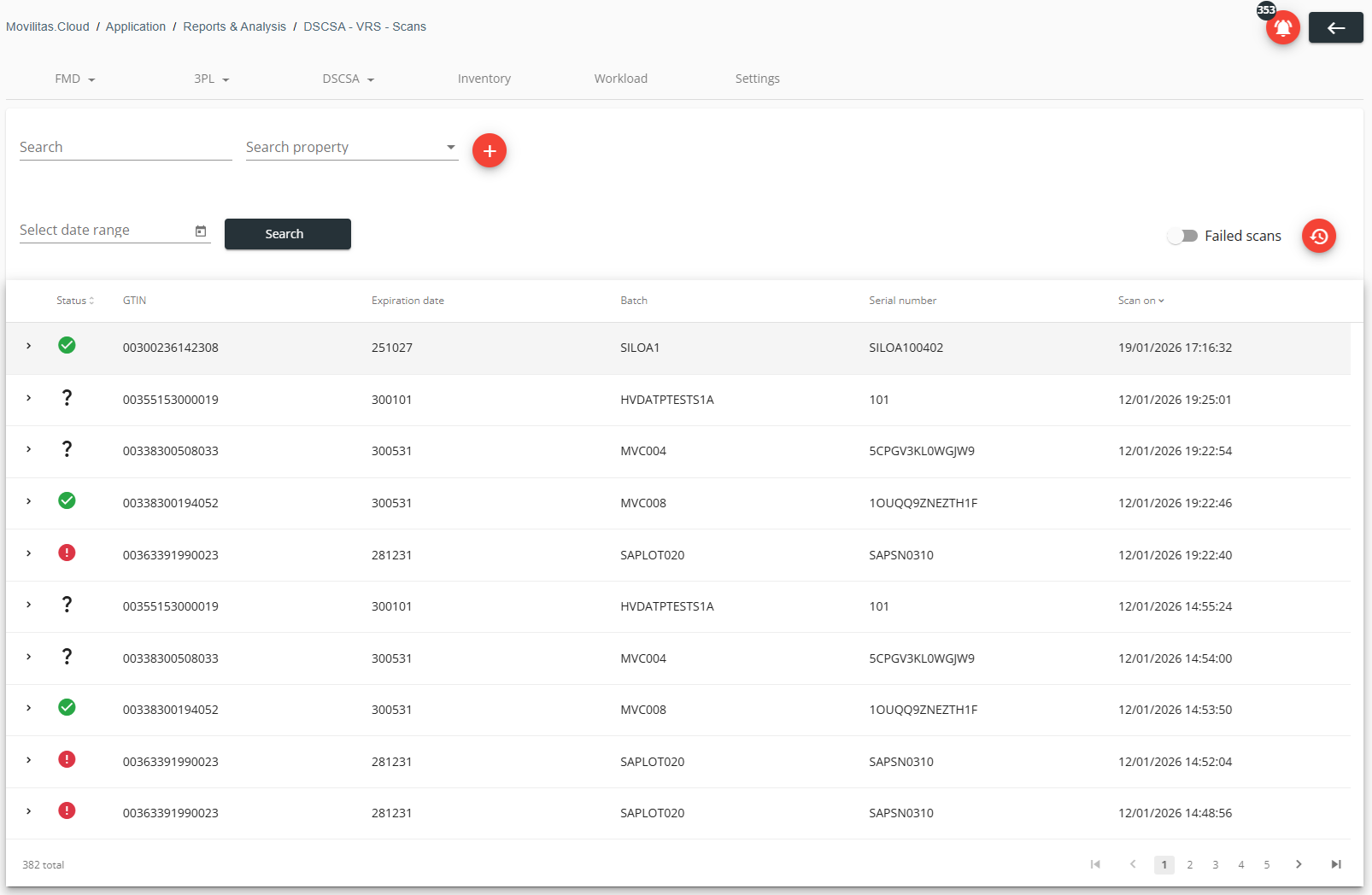
Note: Hover your mouse over the status icon and the application displays the pack status.
2. Search for a specific request by using the filters:
- Set the search properties. The supported search properties are the following: GTIN, serial number, batch, and expiration date.
- Click the + button to add further search criteria. You can set a maximum of three properties.
- Set the date range by using the datepicker.
- Select the Failed scans toggle button to display only the VRS requests that failed due to an error or because the pack is invalid.
You can reset the filter by clicking Reset filters.
3. Click Search. The application filters the list of requests based on the search criteria.
4. Click > (Expand) to view the details of a request.
The provided information contains the pack data, the requester GLN, the response data (the result, the contact information of the responder, and the responder GLN), the responder information, and the timestamps.
If the responder returned an error (verification error), the log contains the error information from the responder. For more information on verification errors, see Verification Error Handling.
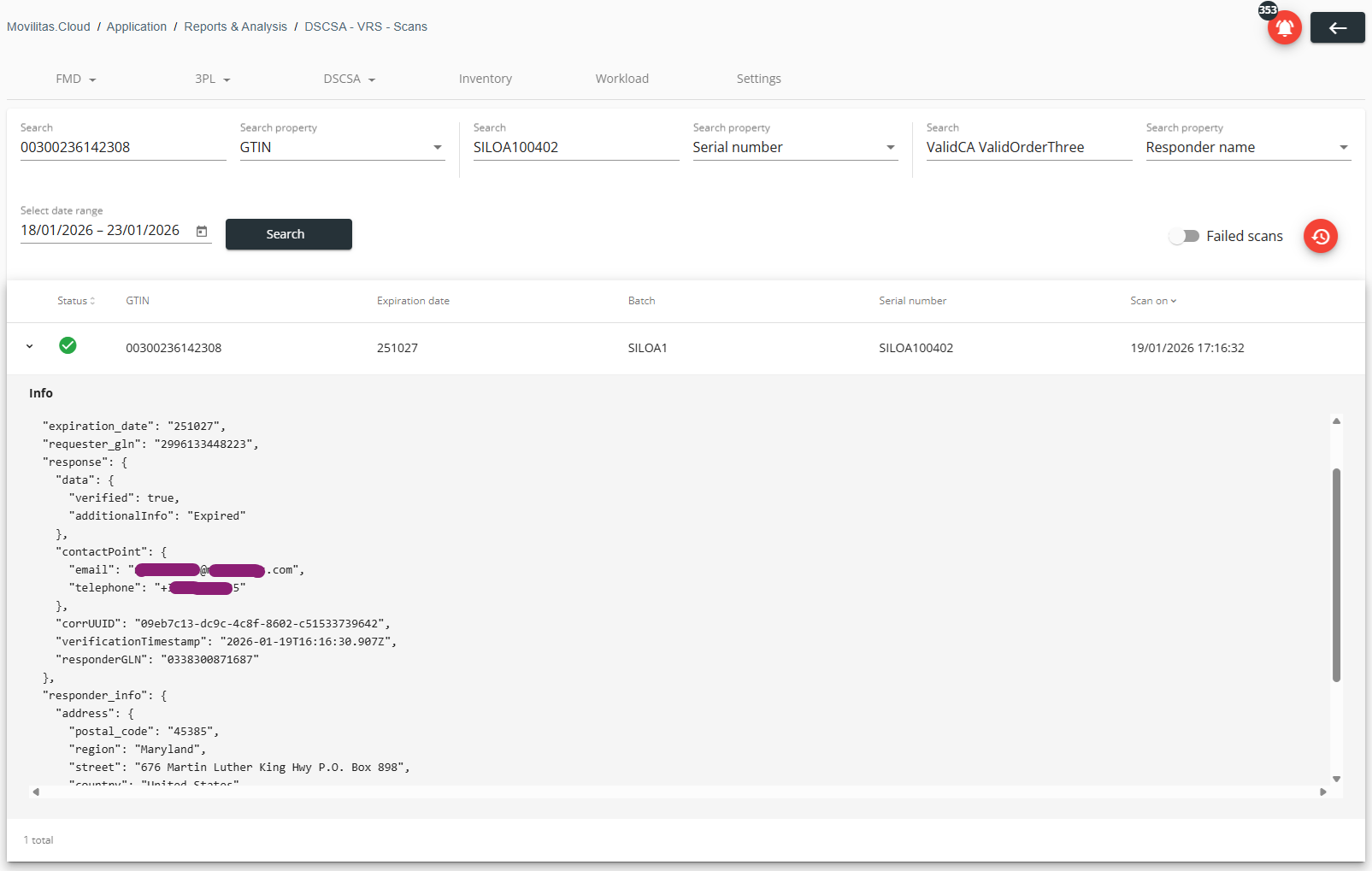
The following example illustrates the details of a request by applying the filters below:
- GTIN
- Serial number
- Responder name
- Specific date range
The pack status is TRUE (valid). After expanding the request, the application displays the pack data, the requester GLN, the response details, the responder information, and the date and time of creation.
- The response details contain the verification result (true - valid pack), the additional information, the contact information of the responder, the correlation UUID, the verification timestamp, and the responder GLN.
- The responder information contains the name and address from the verifiable credential (presentation) of the response. Also, the responder information section indicates whether the verifiable credential (presentation) of the responder was verified (vp_verified), and if so (vp_verified = true), the verifiable credential (presentation) was valid (vp_verification_success = true) or not (vp_verification_success = false).
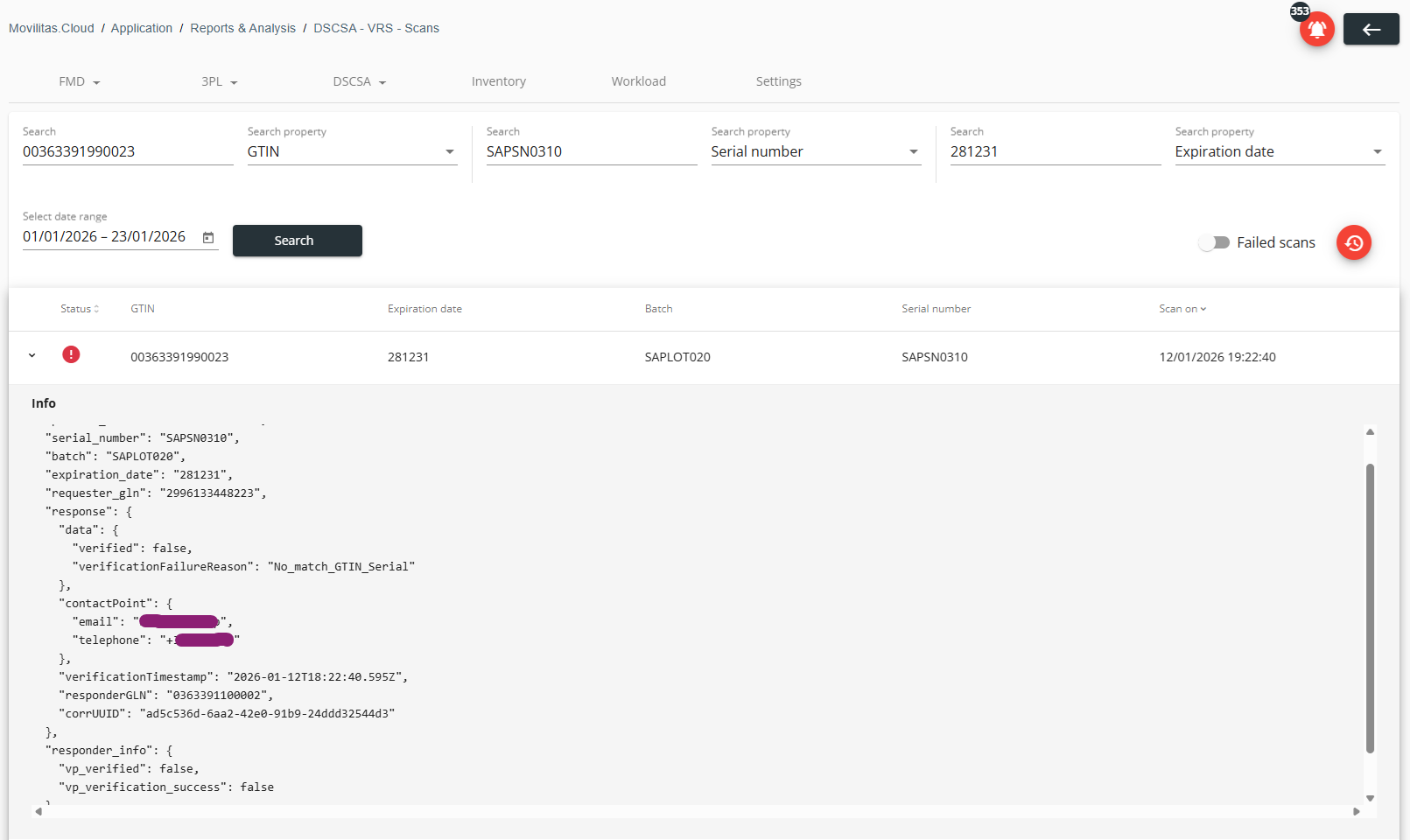
The following example illustrates the details of a request by applying the filters below:
- GTIN
- Serial number
- Expiration date
- Specific date range
The pack status is FALSE (invalid). After expanding the request, the application displays the pack data, the requester GLN, the response details, the responder information, and the date and time of creation.
- The response details contain the verification result (false - invalid pack), the verification failure reason, the contact information of the responder, the correlation UUID, the verification timestamp, and the responder GLN.
- The responder information contains the name and address from the verifiable credential (presentation) of the response. Also, the responder information section indicates whether the verifiable credential (presentation) of the responder was verified (vp_verified), and if so (vp_verified = true), the verifiable credential (presentation) was valid (vp_verification_success = true) or not (vp_verification_success = false).
- In the example below, the verifiable credential (presentation) of the responder was not verified (vp_verified = false).
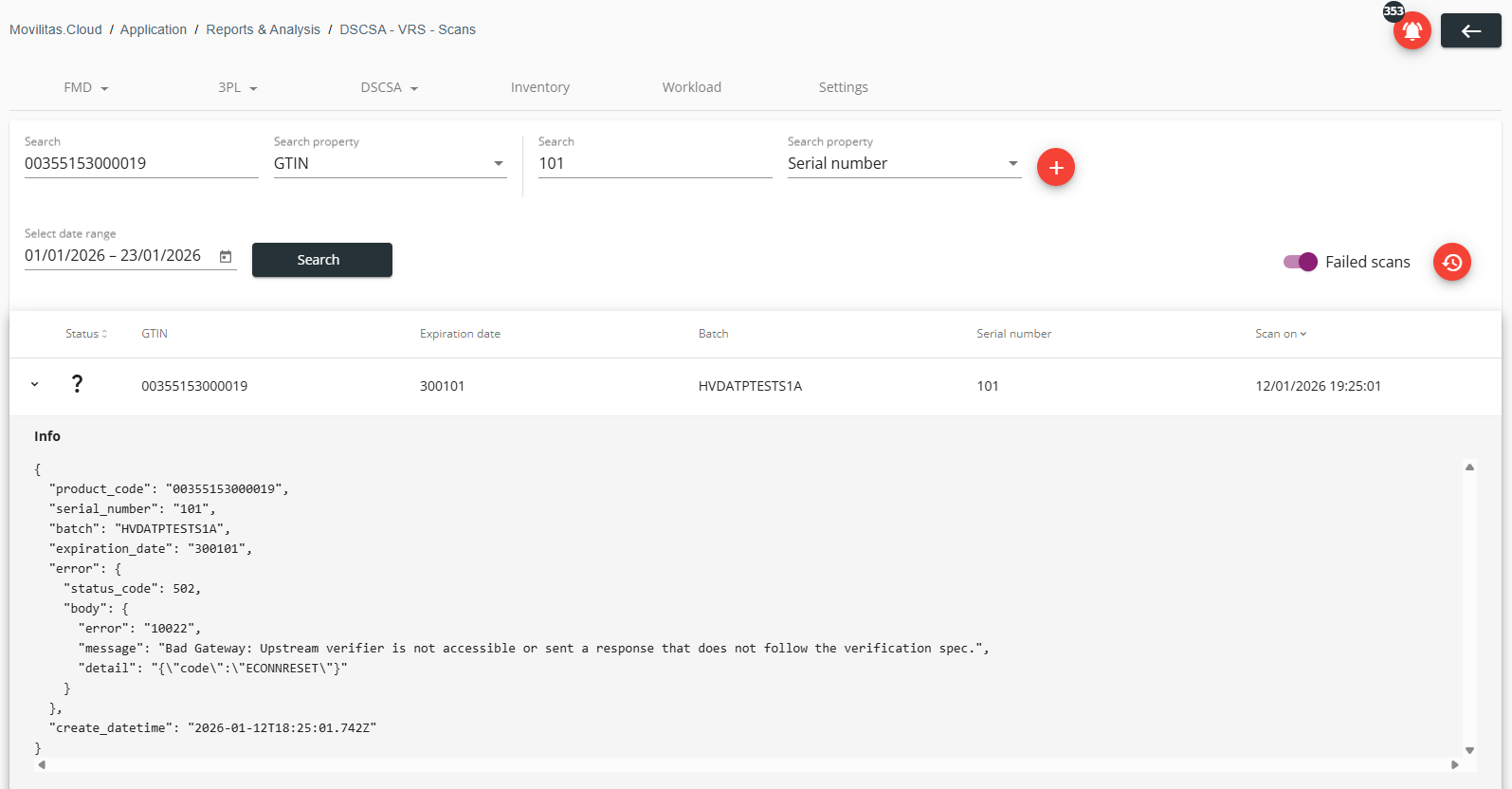
The following example illustrates the details of a request by applying the filters below:
- Failed scans toggle button is ON
- GTIN
- Serial number
- Specific date range
The responder returned an error (verification error). After expanding the request, the application displays the pack data, the error details (status code and body including the error message), and the date and time of creation. The body of the error reflects what the responder returned. For more information on verification errors, the user can consult the Verification Error Handling.
References
The implementation follows the GS1 Lightweight Messaging Standard for Verification of Product Identifiers / Returned Product Identifiers.
- For more information on GS1 verification messaging in general, go to the following GS1 site where you can download a public version of the standard.
- For a US-specific implementation guideline, see the following GS1 link.
